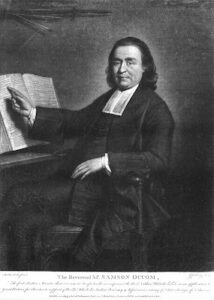
Indian Samson Occom
It is largely credited that Dartmouth College in New Hampshire would never exist except for the efforts of the Mohegan Indian from Connecticut, Samson Occom. Though most accounts credit Eleazar Wheelock as the founder of Dartmouth College, without the subsequent fundraising efforts of Pastor Samson Occom, Dartmouth College may have never materialized.
Samson Occom Early Years
Samson Occom was born in a wigwam in 1723 to the parents of Joshua Tomacham and Sarah Tomacham. His bloodline went directly back to the famous Mohegan chief, Uncas. Theirs’ was a nomadic lifestyle during young Samson’s youth. By the age of 16, Samson Occom was instructed and converted by missionaries more than likely from the Moravian Church. At the age of 17 his conversion to Christianity created in him a deep desire to read. He soon began to study the English language and it wasn’t long before he gained the ability to read.
Samson Occom Meets Eleazer Wheelock
It was the year 1743 when Occom and Wheelock’s paths first crossed each other. A young Mohegan Indian who was schooled by missionaries years earlier when he was of grammar-school age. The effort brought a conversion to Christianity for the young Occom. From 1743 to 1747, Occom and Wheelock spent four years together when Wheelock on his own, taught Occom, preparing him to become an ordained minister. Occom was an excellent pupil. The effort was a success and Occom became an itinerant preacher in the New England and New York areas, doing the same as Wheelock- reaching out to Native American and English students. He was eventually ordained in 1759.
Samson Occom Marries Mary Fowler
Before his ordination, Occom became a schoolmaster on Long Island, teaching the Montauk Native Americans. This is where Samson Occom met his wife, Mary Fowler. They soon started a family eventually having ten children. To support his large family, Occom supplemented his itinerant efforts working as a farmer, fisherman, and cooper. He even learned and worked as a bookbinder.
Samson Occom Meets Up with Eleazer Wheelock Again
It was nearly a decade later since Wheelock last saw his young Mohegan friend in 1747. In 1755, when Occom and Wheelock met up again, Wheelock was desperately aiming to open a school for Native American and British students. Under Occom’s recommendation, Wheelock founded his school for Native American children in Connecticut, Moor’s Charity School in Lebanon, Connecticut. The school accepted both Native American and British students on charity.
In 1759, Occom became an itinerant again, this time reaching out as a missionary to the Oneida Native Americans. Five years later he returned to his native Mohegan tribe.
In 1764, Occom and Wheelock met again. At this time, Wheelock’s charity school was in deep financial trouble. Wheelock proposed a fundraising trip back to the mother country in England. He also recommended that the fundraising effort should be led by his most successful pupil, Samson Occom. Occom agreed and was joined by the Reverend Nathaniel Whitaker. In 1766 the two left for England.
Samson Occom Raises $2.4 Million.
From the book, Black Country:
“Occom and Whitaker are in the middle of a two-year stay in England. Their intention is to raise money for their Indian Charity School in Lebanon, Connecticut. Eleazar Wheelock, a graduate of Yale in the year 1733, owns the institution. The noted preacher and educator is determined in his efforts to educate the young Native American children of the eastern border of America. Currently, Occom and Whitaker are well on their way to acquiring more than ten thousand pounds[1] in contributions.”
The pair will eventually raise 12,000 pounds, more than the $2,000,000.00 in 21st-century monies. The sum was more like $2.4 Million in 21st century value. King George III was a large donor, giving 200 pounds as well as William Second Earl of Dartmouth. It was the latter who knew of a young West-Midlands preacher named Francis Asbury. Many historians admit that Occom’s fundraising efforts aided greatly in the funding of Dartmouth College. Many say it would have been impossible or at the minimum, it would have taken decades for Wheelock to raise those kind of funds. Seeing a Mohegan Indian from the American Colonies preaching in the pulpits of England was an amazing draw for Wheelock’s and eventually, Dartmouth College’s future.
The School charter was signed by Governor John Wentworth in 1769, declaring “that there be a college erected in the province of New Hampshire by the name of Dartmouth College for the education and instruction of youth of the Indian tribes in this land in reading, writing, and all parts of learning which shall appear necessary and expedient for civilizing and Christianizing children of pagans, as well as in all liberal arts and sciences, and also of English youth and others… It shall not exclude any person of any religious denomination whatsoever from any of the liberties and privileges or immunities of the said College on account of his or their speculative sentiments on religion.”
Samson Occom Public Acclaim
According to the article written by, A. LaVonne, Brown Ruoff of Illinois College, Chicago: Occom stepped “into the public limelight in 1771 when he preached the execution sermon for Moses Paul, a fellow Christian Mohegan.”
Moses Paul was ejected from a Bethany Tavern for drunkenness. Outside he awaited the next person to leave the tavern and Moses Paul killed him. The victim was a prominent citizen of Waterbury, a Christian Indian settlement in Connecticut. Moses was granted a three-month reprieve by the General Assembly of Connecticut. Moses penned a letter to Occom on July 16, 1771. His request was for Occom to preach at his hanging which would be held on September 2, 1771.
Drawing a large crowd, New Haven Connecticut executed the Mohegan Christian, the first hanging they had in twenty years. Hearing the famous Mohegan, Samson Occom, preach at the execution of a fellow Mohegan Indian was a large crowd of whites and Native Americans. The audience was moved by the “forceful and emotional sermon.” So much so, that Occom was urged to publish the sermon. In 1772, he did.
This sermon became “one of the few temperance sermons published during the colonial period, it achieved particular popularity because of its application to Indians whose drunkenness whites feared,” and had become known throughout a mostly Christian region.
In addition to Occom’s persuading preaching, he was known to be a fine singer. The success of this published sermon above also led to Occom publishing one other work, Collection of Hymns and Spiritual Songs, (1774).
Pastor Samson Occom
[1] More than two million US dollars in twenty-first-century value.