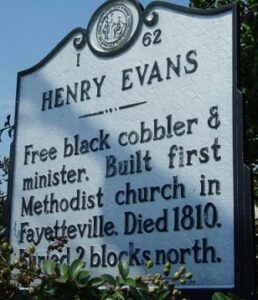
Henry Evans’ Church Marker Fayetteville, North Carolina
Henry Evans Shoemaker
The fifteen-year-old black man is bent over the wooden last. This is a shoe last, designed to mold leather for footwear. He pauses as he patiently raises his head and reaches under the low bench upon which the wooden mold sits upon. Underneath is a storage bin of cordwainer’s tools. Young Henry is a shoemaker.
Henry is quite good at his trade. He learned it well from his father. Henry is the free son of free parents in 1775 Virginia. His parents are faithful followers of the Christian faith. They are members of an exploding church movement which happens to be looked upon as an outcast group of believers. They are a Methodist family. And Methodism in 1775 Virginia is the center of a revival of the Christian faith. It is also slowly becoming a group of individuals who draw suspicion from the local colonists who are rebelling against Great Britain. Methodism is a church movement, not a church, originating within the Church of England. Unfortunately, the leader of this Christian church movement from across the pond has recently written a scathing letter to the unhappy citizens of the American colonies. This has stoked a risky fire for those who attach to the Methodist movement in America.
Despite the growing tensions, Henry and his father do quite well for themselves. Their talent in the much-needed trade of shoe manufacturing and repair has afforded them not only respect, but also that hard-sought-after economic independence. Virginia’s talented black craftsmen clearly support the local economy. They regularly receive orders from the wealthy planters for shoes, ironwork, and carpentry. Henry and his father are at the center of a strong 18th-century, Colonial-American, free-market system. In addition, when the King’s exports become too expensive or not able to be attained, the orders quickly fall to the local artisans. Henry and his father are part of this group.
Henry pauses before diving the pointed tip of the metal awl into the leather, he mumbles: oh to be working on a fine lady’s slipper… He draws back and plunges the sharp tool through the thick leather. It’s a strenuous task. Again, the young man mumbles, and I have to do five more… The lady’s footwear Henry wishes he was actually crafting is known as the “Mule.” This is a much easier task, and a more contemporary product- an Italian import of a delicate material. Or the backless slip-on… a woman’s fine shoe worn indoors. Back to reality… Henry ceases his complaining whispers and focuses on the task at hand.
Despite Henry and his family’s freedom, this is an 18th-century, British colony. A colony firmly entrenched in the enslavement of some Europeans, and mostly Africans. The shoe Henry is working on is not a standard buckled shoe. You know, the ones for the respected middle class and church goers. Nor is it the fancied Ladies slipper or Wool shoes. The ones for the local elites. What Henry is banging out daily, what he just reached into his toolbox to retrieve his sharp, pointed awl which punches holes in the thick leather upper layer of the shoe, is the daily wear of the enslaved Africans and Europeans that work the local tobacco farms.
Each year in the month of February, Henry and his father receive a large order for what many call, “Negro Shoes”. They also go by the name of, “Brogans.” These are coarse-leather shoes, made of heavy-duty material- a bottom of the rung bovine leather. This order services the local slaves of Brunswick, Virginia. With these orders the local slave masters ensure that their labor teams will be properly outfitted for the upcoming work seasons.
Henry Evans and Francis Asbury
Henry and his parents are grateful to be free. But clearly, they struggle for those who are trapped in the evil institution of slavery. Their freedom allows the family to travel about. This is a career-afforded luxury for cordwainers like Henry and his father. And “travel about” they do. Their craft requires a minimum number of tools. Even the shoe-last for men’s and women’s footwear is simplified. It is called, straight-lasted footwear. Straight-lasted means that the wooden mold or last as it is called is the same for both the right and left foot. No need to carry to the next stop a full pair of lasts in several sizes. You only need one last for each size.
This abundant travel is slowly molding young Henry. You see, in a few months he will hear the preaching of the American Colonies’ ultimate traveler, the leader of American Methodism, Francis Asbury. Asbury will land in Norfolk, Virginia near the end of the month of May. Asbury’s visit is mainly to take in what he had heard about for almost a year, that the colony of Virginia was amid a colony-wide revival. Young Henry, as well as his parents, are firmly entrenched in helping to spread the Gospel in Virginia. Their required travels not only have them making shoes, but this extensive travel is also helping them to be a part of this expanding Christian movement.
Unique to the Methodist system set up by John Wesley in England was the fact that in any European or American Methodist society there was very little distinction of class, ethnicity, or gender. In any typical worship service, you could have someone of English nobility worshiping next to an African slave or European indentured servant. The same was true for the Wesley inspired small groups known as the “Class Meeting.” In the Class Meeting the local Class leader and or traveling preacher, whomever was present, would go around the room full of about twenty men and women and check on the individuals’ status of their faith walks. Naturally, in a group this large it would be an informal checkup. Wesley even took this small group gather of men and women and fine-tuned it one step further. The “Band Meeting,” was a more intimate and private meeting of five to six individuals separated by gender. Here the tight group of men would dive deeply in an atmosphere of holding each accountable to walk out their faith in everyday life. The same held true for tight groups of women. These small groups were intense at times, especially if one member’s life was clearly violating scripture. Henry and his parents were leaders in not only the larger, class meetings, but also in the more focused band meetings. The younger Henry naturally amongst several of his peers his age.
It seems that the experience of travel along with the Virginia revival has molded young Henry to freely navigate toward a life as a traveling preacher, a circuit-riding preacher. And the most influential American circuit-riding preacher, Francis Asbury, has his eye on the young Henry.
Henry Evans and Robert Williams
Young Henry, the Henry before 1775, would have been drawn as most young boys of this era, to the societal standing of the traveling preacher. The bold itinerant preacher, arriving to town atop a beautiful but very tired horse, with saddlebags draped across the horse behind the persevering traveler was a sight no young boy could resist. These enamored youths regularly surrounded the arriving champion from some distance out of town. They would happily throw their questions to the wearied but accommodating traveler. Usually starting with: “are you the preacher? The inquiries were consistent for boys of eight to thirteen years of age- asking the age of the horse, name of the horse, can we accommodate the horse, how long are you in town, where are you staying. The welcomed audits always brought a smile to the face of these Biblical Heroes, especially the sight of the boys younger than eight and doing their best to keep up with the captivated group.
To a young, Henry Evans- approximately from the time he was about eleven or twelve years of age, that Biblical warrior on horseback described above would have been the excitable and boldly self-reliant preacher from Ireland, Robert Williams. Never one to wait for long, Williams came to America in 1769. For a time in Ireland, he had petitioned the leader of European Methodism, John Wesley, to be sent as an approved-on-trial, traveling preacher to the American Colonies. Wesley refused at first, admonishing Williams that he needed to leave off preaching against the unreligious Church of England leaders. Williams did his best to accommodate Wesley’s plea, but he just wasn’t wired for comfortable preaching. Especially in light of the fact that the Anglican leadership was less interested in spreading the Gospel of Jesus and more interested in Political maneuvering and gain. In time Robert felt he waited long enough, (maybe a couple of weeks), and headed for the American Colonies on his own. By 1772, he was the leader of Virginia’s explosive revival.
In 1772, great news had spread on the south side of the Roanoke River: “Methodist Circuit Rider, Robert Williams will preach under the big willow oak on the Coleman plantation.” And the revival once again ignites. Unfortunately, William’s spark would only last a short time- passing away unexpectedly in 1775. Francis Asbury preached William’s funeral sermon. In it he is quoted, “no person in America has awakened more souls than has Robert Williams.”
Now what could draw a young Henry Evans to the fiery and unpredictable Robert Williams? Hard to tell, especially when you consider Henry’s eloquent approach to preaching.
Henry Evans Sent to South Carolina
Enter the year, 1780. The colonies have been fighting the mother country, Great Britain, since the mighty nation’s invasion of Boston some five years prior. Henry has not only led a half-dozen of his peers in a band meeting. Now that he is twenty years of age, he has been given the opportunity to not only lead in larger class meetings, but also as per the recommendations of Francis Asbury, young Henry has been asked to preach. And preach he does with such ease and eloquence that at times, the congregations welcome that the busy Asbury or one of his Biblical Calvary will not be preaching this Sabbath, but the eloquent, Henry will once again share an inspiring sermon.
With the American Methodist circuits being much larger than the circuits in Great Britain, the itinerant preacher would normally only visit a church location once a month. The gap was filled by the class leaders, lay leaders, like the twenty-year-old Henry. In addition to the demanding travel there is the unique situation of the free and enslaved Africans worshiping together with the white Europeans. Asbury early in his American career learned to depend on these young, African leaders. And even more if they were free Africans. They were the bridge between the vastly different cultures of the Africans and the Europeans. For men like Asbury, he had no understanding of what the enslaved Africans experienced in the colonies. Men like Henry were the reliable go-between aiding men like Asbury to further the dynamic sense of community embedded into Virginia’s mighty revival.
Although not documented, but highly believed, it was Francis Asbury himself who asked Henry to travel south, to the colony of South Carolina. Specifically, Asbury asked Henry to go to Charleston, South Carolina. Henry agreed and left in 1780.
Henry Evans in Fayetteville, North Carolina
Along the way he had a stop in Fayetteville, North Carolina. According to the 1986 article by, Ralph Hardee Rives, in Fayetteville, Henry was “dismayed by the depravity of the slave populace, he decided to stay and preach. When town authorities forbade such ‘agitation,’ he was obliged to go to the surrounding sandhills to hold services, changing from place to place to escape mob violence. In time, white masters began to recognize an improvement in the manners and morals of his listeners, and eventually the leaders of the Fayetteville community allowed him to preach in town.”
Another source, the Southern Workman, published in 1914, records the mentioning of Henry’s stop in Fayetteville as recounted in the journal entry of Bishop William Capers, “at perceiving of the people of his race in that town were wholly given to profanity and lewdness, never hearing preaching of any denomination and living emphatically without hope and without God in the world. This determined him to stop in Fayetteville; and he began to preach to the Negroes, with great effect.”
Capers in, the Southern Workman, continues: “The town council interfered, and nothing in his power could prevail with them to permit him to preach. He then withdrew to the sandhills outside of the town, and held meetings in the woods, changing his appointments from place to place. No law was violated, while the council was effectually eluded; and so the opposition passed into the hands of the mob. These he worried out by changing his appointments, so that when they went to work their will upon him he was preaching somewhere else. Meanwhile, whatever the most honest purpose of a simple heart could do to reconcile his enemies was employed by him for that end. He eluded no one in private but sought opportunities to explain himself; avowed the purity of his intentions, and even begged to be subjected to the scrutiny of any surveillance that might be thought proper to prove his inoffensiveness.
Happily for him and the cause of religion, his honest countenance and earnest pleadings were soon powerfully seconded by the fruits of his labors. One after another began to suspect their servants of attending his preaching, not because they were made worse, but wonderfully better. The effect on the public morals of the Negroes, too, began to be seen, particularly as regarded drunkenness and their habits on Sunday. It was not long before the mob was called off by a change in the current of opinion, and Evans was allowed to preach in town. At that time there was not a single church edifice in the city… and it was plainly Evans or nobody to preach to the Negroes.”
By the year 1800, Evans was preaching regularly to Fayetteville faithfully from a newly erected but sparse building. The congregation was full of both Africans and Europeans drawn to the impassioned and touching preaching of Henry Evans. As word of this growing church spread, visitors from nearby would make it a point to be in Fayetteville on a Sunday to hear Henry preach. By 1802, the wood siding boards were removed to make additional space for the expanding congregation.
Henry Evans and Francis Asbury Again
In 1788, Francis Asbury arrived at Fayetteville. Unfortunately, he was deathly ill with a malaria-like illness. He failed to make it to Evan’s church. Not until 1803 does Asbury’s journals mention Henry Evans and his growing church in Fayetteville. Finally, in December of 1805, Asbury visits Evan’s church in Fayetteville. Preaching to an overcrowded house of both white and black congregants, Asbury referred to Evan’s church as “The African meeting house.” On January 6th, 1806, Asbury returned to Evan’s church. On the 12th, he preached alongside Henry, acknowledging the significant work of Henry Evans.
Unfortunately, Asbury did not know that Henry’s health was failing. The forty-six-year-old man was struggling. As his church continued impressive growth, Henry realized that his time was short. He petitioned, through Asbury, for the Methodist Episcopal Church in America to adopt his church. In 1808, this adoption became reality, Francis Asbury himself inviting this vibrant congregation.
Henry Evans’ Last Days
For nearly two years, Henry’s health slowly faded. In December of 1809, Henry put together an extensive will which included deeding the Fayetteville Church property to America’s Methodist Episcopal Church denomination. This was Henry’s dying wish. Asbury accepted this thriving congregation of black and white worshipers. The will included the church building and an adjacent lot which was used for church functions. There was one small request, that the pastor’s home, part of the church property, would not be deeded to the Methodist Episcopal denomination until the death of his widowed wife. Asbury and company agreed to this. Evans passed late in 1810.
Asbury would return to Fayetteville in December of 1811. He is reported to attend the church Evan’s built. From the journal of Francis Asbury, dated, Sabbath, February 3, 1811: “Preached; our house is too small: preached in the afternoon; we must enlarge our house.” This house was the Church which Evan’s built.
William Capers, the preacher who succeeded Evans in Fayetteville, is quoted as journaling about Evan’s last words to the congregation. Capers offered:
“On the Sunday before his death . . . the little door between his humble shed and the chancel where I stood was opened, and the dying man entered for a last farewell to his people. He was almost too feeble to stand at all, but supporting himself by the railing of the chancel, he said, ‘I have come to say my last word to you. It is this: None but Christ.
Three times I have had my life in jeopardy for preaching the gospel to you. Three times I have broken the ice on the edge of the water and swum across the Cape Fear [River] to preach the gospel to you. And now, if in my last hour I could trust to that, or to anything else but Christ crucified, for my salvation, all should be lost, and my soul perish forever.’
A noble testimony! Worthy, not of Evans only, but St. Paul. His funeral at the church was attended by a greater concourse of persons than had been seen on any funeral occasion before. The whole community appeared to mourn his death, and the universal feeling seemed to be that in honoring the memory of Henry Evans we were paying a tribute to virtue and religion. He was buried under the chancel of the church of which he had been in so remarkable a manner the founder.”